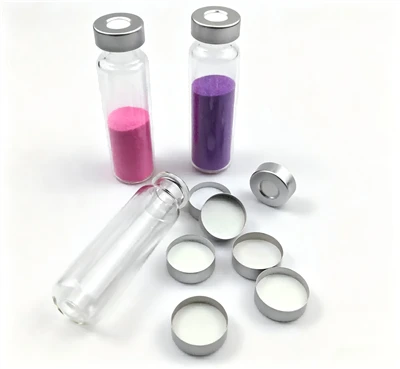


Material
Glass Material
Advantages:
1.High chemical stability. It can withstand most chemical reagents, including acids, alkalis, and organic solvents. For example, in high - performance liquid chromatography (HPLC) analysis, when the sample is a complex system containing various organic components and buffer salts, the glass sample vial will not react with the sample, thus ensuring that the composition and properties of the sample are not interfered.
2.Good transparency, which is convenient for observing the state, volume, and the presence of impurities of the sample. In gas chromatography (GC) analysis, it is possible to clearly see whether there are bubbles or suspended solids in the sample, which is very important for ensuring the accuracy of injection.
Disadvantages:
1.Fragile. During laboratory operations, if it is accidentally dropped or bumped, it is easily broken. This will not only lead to sample loss, but also may cause harm to laboratory personnel.
Plastic Material
Advantages:
1.High impact resistance. Compared with glass sample vials, plastic sample vials are more durable. In some situations where frequent movement is required or field sampling is carried out, plastic sample vials can better protect the sample and reduce sample loss caused by vial breakage.
2.Relatively low cost. For some large - scale experiments with not particularly high requirements for the accuracy of sample vials, the use of plastic sample vials can effectively reduce the experimental cost.
Disadvantages:
1.Limited chemical resistance. Some organic solvents or strong acids and alkalis may react with the plastic, resulting in deformation of the sample vial, sample contamination, or adsorption on the vial wall. For example, some plastic sample vials cannot be used for samples containing strong organic solvents such as chloroform, because chloroform may dissolve the plastic.
Specifications
Capacity
1.It needs to be selected according to the injection volume and the requirements of the analytical instrument. Common sample vial capacities include 1ml, 2ml, 10ml and other specifications.
2.For micro - analysis, such as some high - sensitivity gas chromatography - mass spectrometry (GC - MS) analysis, the injection volume may be only a few microliters. At this time, a 1ml or 2ml sample vial is more appropriate. Because such a small - capacity sample vial can reduce the volatilization and diffusion of the sample in the vial and ensure the accuracy of injection. For cases where a large amount of sample pretreatment is required or the sample volume itself is relatively large, such as the inductively coupled plasma - mass spectrometry (ICP - MS) analysis of heavy metal elements in environmental water samples, a 10ml or even larger - capacity sample vial may be required.
Vial Mouth Size
1.The vial mouth size should match the cap and injection equipment used. There are usually two types: threaded and snap - on.
2.The threaded sample vial has better sealing performance and can effectively prevent sample leakage and volatilization. In liquid chromatography analysis, when the mobile phase contains volatile components or the sample needs to be stored for a long time, the threaded sample vial is a better choice. The snap - on sample vial is more convenient for quick opening and closing and is more convenient in some experimental operations that require frequent sampling.
Other Factors
Cap Types
Common ones include silicone septa and PTFE/silicone composite septa. The silicone septum has good elasticity and sealing performance, can adapt to the puncture of different - shaped injection needles, and can quickly resume the sealing state after puncture, reducing sample volatilization and the entry of external impurities. The PTFE/silicone composite septum combines the chemical inertness of polytetrafluoroethylene (PTFE) and the elasticity of silicone and is suitable for samples with extremely high requirements for chemical purity, such as the analysis of trace organic pollutants.
Special Treatments or Not
Some sample vials will be silanized. The inner surface of the silanized sample vial is smoother and can reduce the adsorption of sample molecules on the vial wall. When analyzing some trace substances that are easily adsorbed on the container surface, such as bio - active small molecules or trace environmental hormones, using silanized sample vials can improve the sample recovery rate and the accuracy of analysis.

- Recommend related products
- Glass vial


Factroy Information

Rufluor has 10 clean production lines for PTFE silicone composite gaskets, as well as a gasket and cover composite production line and a cover and gasket assembly production line. Provide customers with a complete product series, including Sample vials from 1ML to 2000ML, cap pads from 4mm to 55mm in diameter, and a full range of syringe filters.
It has been OEMed for many well-known scientific instrument companies at home and abroad. They come from pharmaceutical, life science, chemistry, technology, food processing and other industries. At the same time, we also have customers from universities, research institutes, government agencies, and environmental testing agencies, etc. The quality is trustworthy.
Package

Hot Tags: pre-assembled screw headspace vial, China pre-assembled screw headspace vial manufacturers, suppliers, factory, hplc amber vial, hplc sample vial with cap, hplc vial for autosampler, hplc vial inserts, hplc vial ptfe silicone septa, screw cap sample vials